
Every shop owner knows the feeling: the system says you have 24 bottles, the shelf says 19. A stock take is how you find out where those five went, and how you make sure your records are worth trusting.
This guide explains what a stock take is, the different kinds of count, how to run one properly, and how to turn the results into fewer losses. It applies whether you run a duka, a minimart, a pharmacy, a restaurant kitchen or a bar.
What is a stock take?
A stock take is a physical count of everything you have in stock, compared against what your records say you should have. The difference between the two is called the variance.
- Negative variance means you have less than expected. Causes include theft, breakage, expired goods, unrecorded sales, or receiving errors.
- Positive variance means you have more than expected. Causes include unrecorded deliveries, sales rung up as the wrong item, or a previous miscount.
Both kinds matter. A positive variance often hides a negative one somewhere else.
Why stock taking matters
It's tempting to skip counting when the shop is busy. But your stock records drive almost every decision you make:
- What to reorder. If the system thinks you have 20 packets of sugar and you actually have 4, you'll run out before you reorder.
- How much profit you made. Your cost of goods sold depends on accurate stock. Wrong stock numbers mean wrong profit numbers. See sales vs profit for why that matters.
- Whether you have a loss problem. Without a count, theft and waste are invisible until the cash runs short.
A stock take is the reality check that keeps all of this honest. For the habits that keep stock accurate between counts, read how to manage stock in a small shop.
Three kinds of count
| Type | What you count | When it's useful |
|---|---|---|
| Full count | Every item in the shop | At least once a year, and before year-end accounts |
| Cycle count | A small group of items on a rolling schedule | Weekly or monthly, without closing the shop |
| Spot check | One or two items you're suspicious about | Any time something feels off |
Most small shops do best with a full count once or twice a year plus cycle counts in between. Cycle counting catches problems while they're still small, and you never need to close for a whole day.
How often should you count each item?
| What | How often | Why |
|---|---|---|
| High-value or high-theft items (spirits, phones, airtime, cosmetics) | Weekly, or even daily | Small losses add up fast |
| Fast movers (bread, milk, sodas, cooking oil) | Every 2–4 weeks | High volume hides errors |
| Everything else | Monthly or quarterly | Keeps records honest |
Before the count: preparation
A stock take is only as good as the preparation behind it.
- Pick a quiet time. Early morning before opening, after closing, or your slowest day. Counting during a rush leads to mistakes.
- Finish your paperwork first. Record every delivery, return and transfer before you start. Unrecorded paperwork is the most common cause of false variances, and it's why good supplier records matter.
- Tidy the shelves. Group the same items together and move damaged or expired goods to one clearly marked area.
- Split the shop into sections, such as shelves, the store room, fridges and behind the counter. Assign each section to one counter.
- Decide how to handle sales during the count. Either stop selling the items being counted, or use a system that accounts for sales made while counting is under way.
During the count: do it blind
The most important rule: counters should not know what the system expects.
If a counter knows the system says 24, they tend to "find" 24. In a blind count, people record what is actually there rather than what they expect to see.
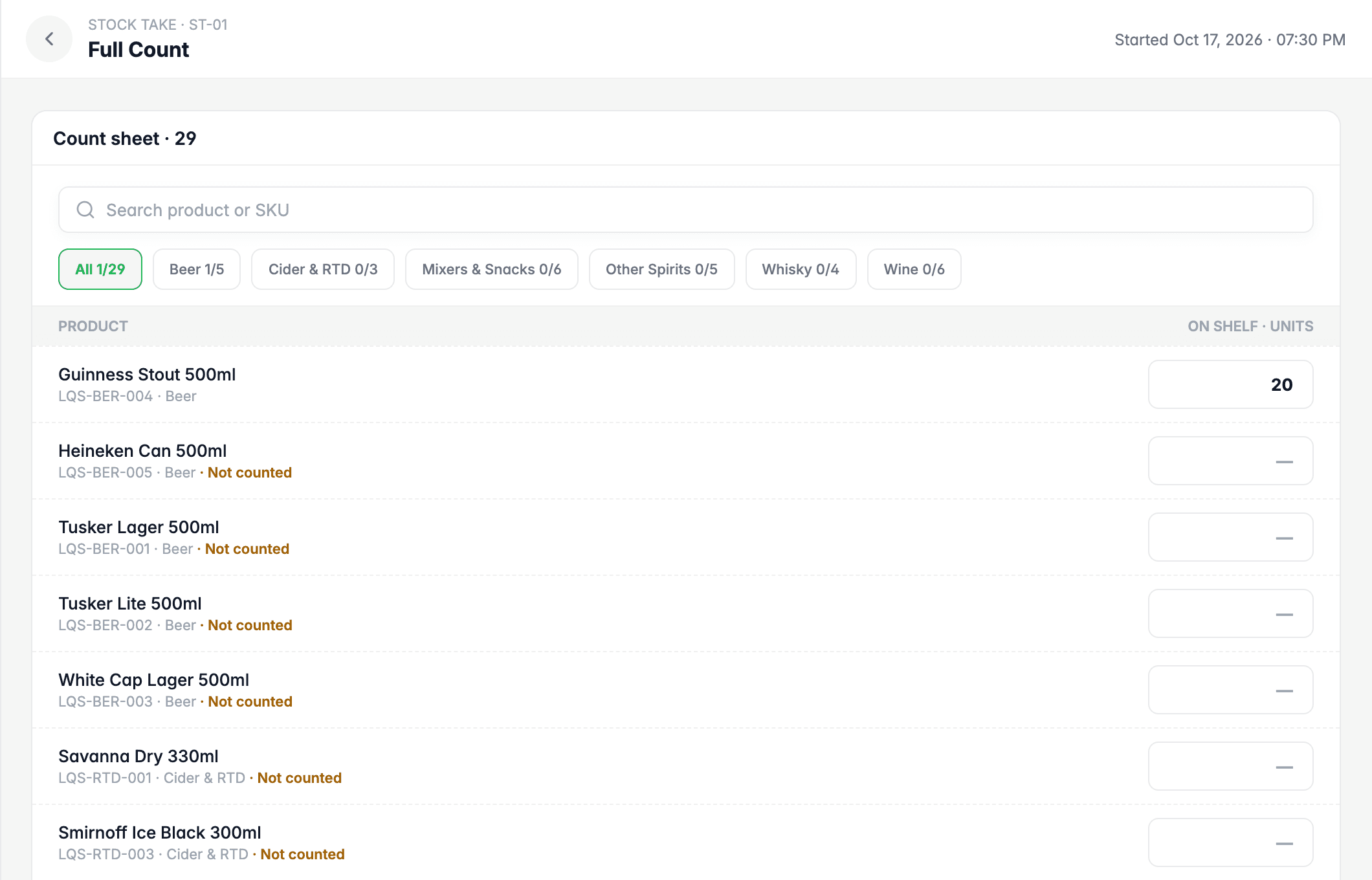
Tips for an accurate count:
- Count in the selling unit. If you sell single sodas, count singles, not crates. Note opened packs separately.
- Count shelf by shelf, left to right, top to bottom. Don't jump around.
- Use two counters for valuable items. One counts, one records, then swap.
- Don't forget hidden stock: the store room, under the counter, the back of the fridge, and stock that has been sold but not yet collected.
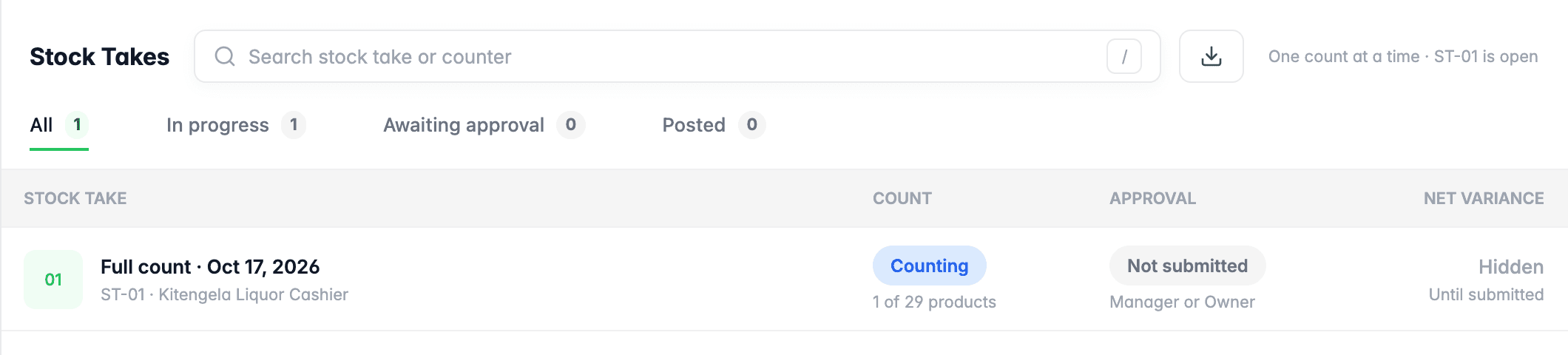
FaidaPOS stock takes are blind by design. The variance stays hidden until the count is submitted, and only a manager or owner reviews and approves it.
After the count: investigate before you adjust
The temptation is to simply overwrite the system numbers with the count and move on. Don't, at least not before you've looked at the big variances.
1. Recount the biggest gaps
Sort by value, not by quantity. Five missing bottles of whisky matter more than twenty missing sweets. Recount anything with a large variance before you accept it.
2. Look for matching pairs
A shortage of one item and an excess of a similar item (500 ml and 1 L, or two flavours) usually means sales were rung up as the wrong product, not that stock was stolen.
3. Check what moved during the count
If you kept selling, make sure sales during the count are reflected. FaidaPOS records the net stock movement between when a count started and when each product was counted, so ongoing sales don't show up as false variances.
4. Approve, then post
Have a manager or owner review and approve the count before it updates stock levels. That separation means a single person can't both create and hide a loss.
Reading the results: your shrinkage rate
Shrinkage is stock you paid for but can no longer sell, whether it was stolen, expired, broken or never recorded. Track it as a percentage so you can compare one period with another:
Shrinkage rate = value of stock lost ÷ value of sales for the period × 100
For example, if you lost KES 12,000 worth of stock (at cost) in a month when you sold KES 600,000, your shrinkage rate is 2%.
There's no single "right" number, but if your rate keeps climbing, something in your process is broken. Look at receiving, cashier training, expiry management or security.
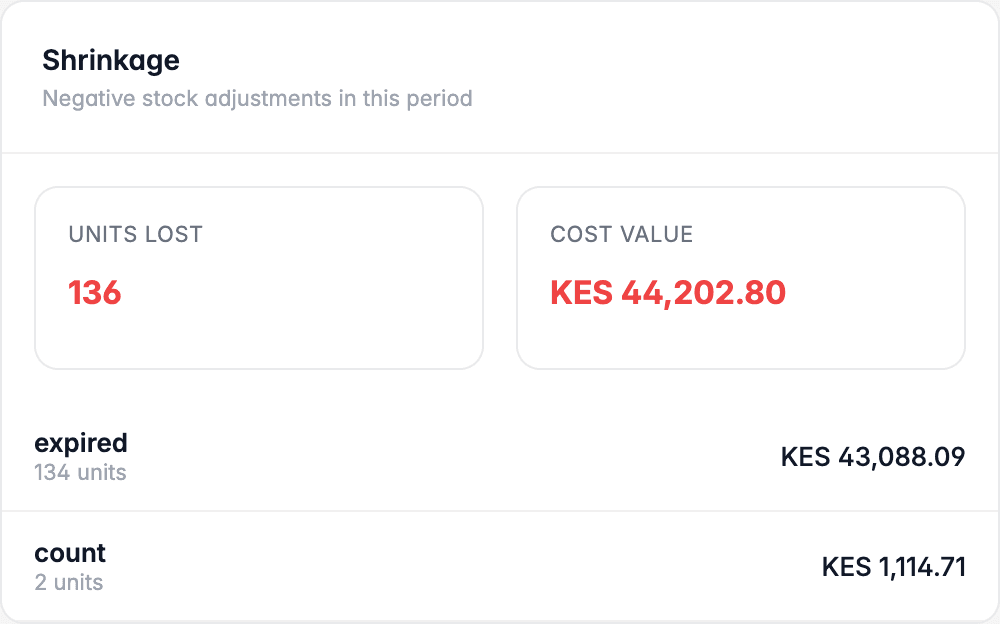
In the example above, almost all of the loss came from expired stock, not theft. That's a very different fix: better ordering and first-expiry-first-out rotation, not more security.
Stopping losses between counts
A stock take shows you the problem. These habits prevent it:
- Check deliveries in properly. Count against the delivery note before the supplier leaves.
- Record breakages and expiries immediately, not at the next stock take.
- Give each cashier their own login so every sale and void can be traced.
- Restrict who can adjust stock levels. Not everyone needs that permission.
- Use purchase orders so you can compare what you ordered, what arrived, and what you paid for.
The bottom line
A stock take isn't only a yearly chore for the accountant. Done regularly and done blind, it's one of the best ways to protect your margins. Once you know where your stock goes, you can stop it going.
Running a minimart? Stock taking is one part of the bigger picture in our guide to managing a minimart in Kenya.